
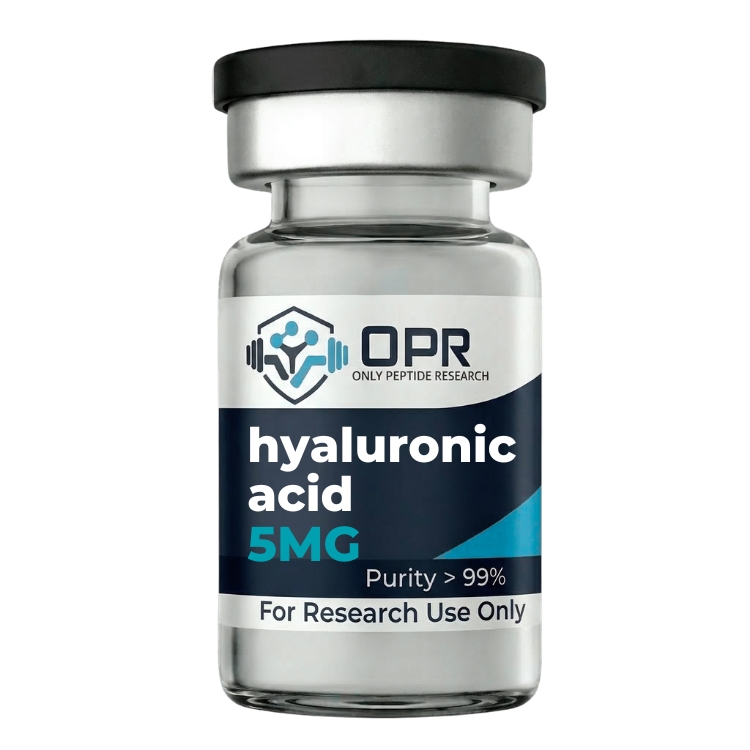
Size: 5mg
Contents: Hyaluronic Acid (5mg)
Form: Research-Grade Material
Quantity: 10 Vials

Hyaluronic Acid is a naturally occurring polysaccharide widely studied in laboratory research for its role in extracellular matrix structure, cellular interactions, hydration, and biomaterial science. Researchers investigate hyaluronic acid in controlled laboratory environments to better understand its molecular properties and interactions with biological systems.
Due to its distinctive water-binding properties and presence within extracellular matrices, hyaluronic acid is commonly researched in studies involving cellular biology, tissue structure, biomaterials, and molecular signaling. Its versatile research profile continues to support investigations into cell-matrix interactions and biochemical processes.
Hyaluronic acid is a naturally occurring glycosaminoglycan found in various biological tissues and extracellular matrices. Researchers study its physical and biochemical characteristics to better understand hydration, matrix organization, and cellular interactions.
Laboratory investigations continue to explore how hyaluronic acid behaves under different experimental conditions and how its molecular properties may influence interactions with cells and extracellular structures.
Compound Type: Research-Grade Polysaccharide
Research Focus: Extracellular matrix and cellular interaction research
Primary Function: Biomaterial and molecular research
Research involving hyaluronic acid focuses on its interactions with extracellular matrix components and cell-surface receptors. Scientists investigate how its molecular characteristics influence cellular communication and matrix-related processes.
Researchers also examine its water-binding capacity and polymer properties in controlled laboratory models to better understand its behavior in biological and biomaterial research.
Hyaluronic Acid is commonly investigated in laboratory studies focused on:
Its unique molecular and physical properties make hyaluronic acid a valuable compound for research involving cellular biology and biomaterial science.
Hyaluronic acid continues to attract scientific interest because of its important role within extracellular matrices and its ability to interact with water and biological structures. Researchers continue to study its molecular behavior across different experimental models.
Ongoing laboratory investigations aim to improve understanding of its physicochemical properties, cellular interactions, and extracellular matrix-related mechanisms.
Product Name: Hyaluronic Acid
Content: 5mg per vial
Quantity: 10 Vials
Form: Research-Grade Material
Store in a cool, dry place away from direct sunlight, heat, and moisture. Follow established laboratory storage protocols and manufacturer recommendations to help maintain product stability and research-grade quality.
Hyaluronic Acid is intended strictly for research and laboratory use only. It is not approved for human consumption, medical use, or therapeutic applications. All handling and experimentation must be performed by qualified professionals in accordance with applicable laws and regulations.