
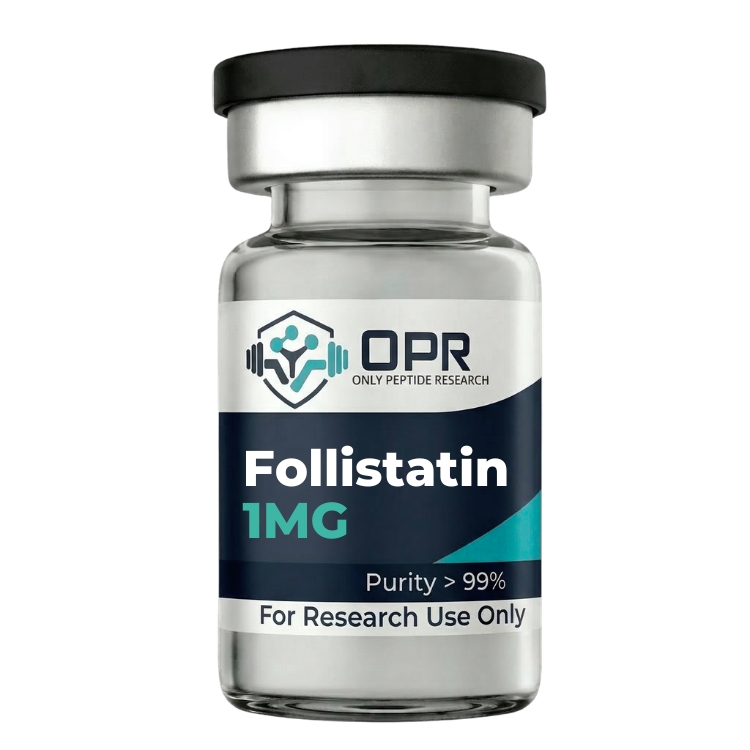
Size: 1mg
Contents: Follistatin (1mg)
Form: Lyophilized Powder
Purity: ≥99%
Quantity: 10 Vials

Follistatin is a naturally occurring glycoprotein studied in laboratory research for its interactions with activin and related members of the transforming growth factor-beta (TGF-β) superfamily. Researchers investigate Follistatin in controlled experimental environments to better understand growth-factor signaling, protein interactions, cellular regulation, and muscle-related biological pathways.
Due to its ability to interact with signaling proteins such as activin, Follistatin has attracted scientific interest in research involving cellular communication, growth-factor regulation, reproductive biology, and skeletal muscle signaling. Ongoing laboratory studies continue to examine its molecular characteristics and interactions with different signaling pathways.
Follistatin is a secreted glycoprotein that functions as a binding protein for several members of the TGF-β superfamily. Researchers study Follistatin to better understand how protein-protein interactions can influence signaling pathways and cellular responses.
Laboratory investigations examine the molecular structure of Follistatin and its interactions with activin and other signaling molecules. These studies contribute to a broader understanding of growth-factor biology and cellular regulation.
Compound Type: Recombinant Research Protein
Research Focus: Activin and TGF-β superfamily signaling research
Primary Function: Growth-factor and protein interaction research
Research involving Follistatin focuses on its ability to bind to specific signaling proteins, including activin. By studying these interactions, scientists can investigate how extracellular protein binding influences downstream cellular signaling pathways.
Researchers continue to examine Follistatin’s molecular interactions and its role in regulating signaling activity within controlled experimental models. These investigations help characterize protein-mediated communication and related biological mechanisms.
Follistatin is commonly investigated in laboratory studies focused on:
Its distinctive protein-binding properties make Follistatin relevant to scientific research involving growth-factor signaling, cellular communication, and regulatory pathways.
Follistatin has attracted considerable scientific interest because of its interactions with activin and other TGF-β superfamily proteins. Researchers continue to investigate how these protein interactions influence signaling pathways in different experimental systems.
Ongoing laboratory research aims to expand understanding of growth-factor regulation, protein binding, cellular signaling, and related biological processes. Further studies may provide additional insights into the molecular characteristics and research applications of Follistatin.
Product Name: Follistatin
Content: 1mg per vial
Quantity: 10 Vials
Form: Lyophilized Powder
Purity: ≥99%
Store in a cool, dry place away from direct sunlight, heat, and moisture to help maintain product stability and research-grade quality. Refrigeration may be appropriate according to established laboratory storage protocols. After reconstitution, follow applicable laboratory procedures and stability requirements for proper storage and handling.
Proper storage under controlled laboratory conditions can help preserve the integrity of the recombinant research protein and support consistent experimental research. Always handle and store the product according to appropriate laboratory protocols and keep it in a secure environment intended for qualified research professionals.
Follistatin is intended strictly for research and laboratory use only. It is not approved for human consumption, medical use, or therapeutic applications. This product is not intended to diagnose, treat, cure, or prevent any disease or condition. All handling and experimentation must be performed by qualified professionals in accordance with applicable laws, regulations, and institutional laboratory protocols.